Entertainment
Get ThriftyEvents.net Blog: The Complete Guide to Affordable Event Planning and Memorable Celebrations


The Desolation of Smaug is one of the most memorable elements of J.R.R. Tolkien’s fantasy world, combining ancient treasure, dragon mythology, dwarven history, and the struggle to reclaim a lost homeland. The name is closely associated with The Hobbit: The Desolation of Smaug, the second film in Peter Jackson’s The Hobbit trilogy. It describes the devastation caused by Smaug, a powerful dragon who conquered the dwarven Kingdom under the Mountain and transformed the surrounding region into a symbol of fear and ruin.
To understand the full meaning of the Smaug desolation, we need to explore the dragon’s origins, the fall of Erebor, the significance of the Lonely Mountain, and the journey undertaken by Thorin Oakenshield and his companions. Through these interconnected events, we discover a story about greed, courage, displacement, and the consequences of allowing power and possessions to control our decisions. The Desolation of Smaug is not simply a landscape destroyed by a dragon; it represents the lasting impact of a catastrophe on an entire community and the difficult path toward restoration.
1. What Is the Desolation of Smaug?
The Desolation of Smaug refers to the devastation associated with Smaug’s occupation of the Lonely Mountain and the surrounding lands in Tolkien’s fictional world of Middle-earth. Before the dragon’s arrival, Erebor was a prosperous dwarven kingdom renowned for its mineral wealth, magnificent halls, skilled craftsmen, and extraordinary treasures. Its location near the town of Dale and the Long Lake helped support a thriving regional economy, connecting dwarven industry with human trade and settlement.
Everything changed when Smaug attacked the mountain. Drawn by the enormous wealth accumulated beneath Erebor, the dragon descended upon the kingdom, drove away its inhabitants, and claimed the treasure for himself. The dwarves were forced to flee, while the nearby human settlements suffered destruction and loss. The region subsequently became associated with danger, abandonment, and the overwhelming presence of the dragon.
The word desolation captures the consequences of this conquest. A place that once supported trade, craftsmanship, and community became a territory overshadowed by fear. The Lonely Mountain remained filled with riches, but those riches no longer benefited the people who had created and protected them. Smaug’s possession of the treasure illustrates a central theme of Tolkien’s storytelling: wealth can become destructive when it is separated from responsibility, generosity, and the well-being of others.
In the film adaptation, The Hobbit: The Desolation of Smaug, this conflict forms the foundation of the adventure. The story follows Bilbo Baggins, Thorin Oakenshield, and their companions as they continue their dangerous expedition toward Erebor, hoping to confront the dragon and reclaim the dwarves’ ancestral home.
2. Who Is Smaug, the Dragon of the Lonely Mountain?
Smaug is one of the most recognizable dragons in modern fantasy literature. In Tolkien’s The Hobbit, he is an intelligent, powerful, proud, and exceptionally dangerous creature whose defining characteristics include his immense strength, fiery breath, cunning personality, and obsession with treasure. Rather than behaving like a mindless monster, Smaug understands the psychology of his enemies and frequently uses intimidation, deception, and conversation to gain an advantage.
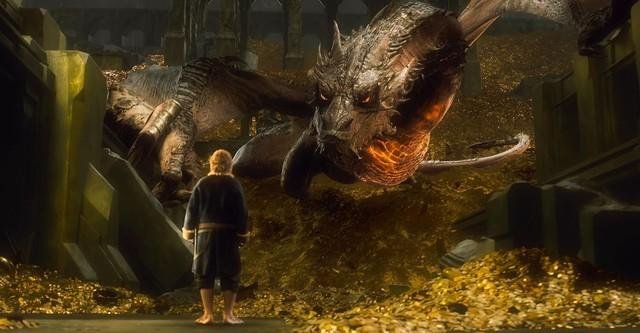
After driving the dwarves from Erebor, Smaug settles among their accumulated riches. His body becomes covered with protective layers of precious objects, although a vulnerable patch beneath his left breast later becomes important to the story. His confidence in his apparent invulnerability reflects his arrogance and helps explain why he underestimates the possibility of being challenged.
In Peter Jackson’s film adaptation, Smaug is brought to life through detailed visual effects and the voice performance of Benedict Cumberbatch. The dragon appears enormous, with a powerful body, expansive wings, sharp features, and an expressive face that communicates intelligence as well as aggression. His scenes inside the mountain emphasize the contrast between the dwarves’ desire to recover their heritage and Smaug’s determination to retain everything he has stolen.
Smaug also represents the destructive potential of greed. Although he possesses enough gold to satisfy almost any material desire, he has no interest in sharing it, using it constructively, or building a lasting society. His treasure becomes valuable to him primarily because it belongs to him. This makes him more than a physical obstacle: he is a symbol of possessiveness, pride, and power without responsibility.
3. The Fall of Erebor and the Kingdom’s Lost Glory
To understand the significance of the Smaug desolation, we must examine the history of Erebor, the Lonely Mountain. Under the leadership of the dwarven king Thrór, Erebor became a center of wealth and craftsmanship. Its halls contained vast quantities of gold, jewels, and finely made objects, while its skilled inhabitants developed a reputation for producing extraordinary metalwork and valuable treasures.
The prosperity of Erebor benefited neighboring communities. Dale, a human settlement near the mountain, developed commercial and cultural connections with the dwarves. Trade created opportunities for both societies, making the region an important center of economic activity. The arrival of Smaug destroyed this balance, transforming a prosperous area into a dangerous place dominated by the dragon’s presence.
The attack forced the dwarves to abandon their ancestral home and scattered survivors across Middle-earth. Thorin Oakenshield, the grandson of Thrór, grew up determined to restore his people’s former standing. His ambition eventually developed into the central objective of the quest in The Hobbit.
The loss of Erebor carries emotional significance because the dwarves are not simply trying to recover gold. They want to regain their identity, homeland, traditions, and place in the world. Their memories of the mountain represent a connection to previous generations, while their exile reminds them of everything they have lost.
Nevertheless, reclaiming Erebor presents difficult questions. What does it mean to restore a kingdom after years of displacement? Can a community recover its heritage without becoming consumed by the wealth it seeks? These questions become increasingly important as Thorin approaches his destination and the treasure that awaits beneath the mountain.
4. Bilbo Baggins and the Quest to Reclaim the Lonely Mountain
The story of The Hobbit: The Desolation of Smaug continues the journey of Bilbo Baggins and the thirteen dwarves led by Thorin Oakenshield. Gandalf the Grey helps guide the larger mission, although his investigation into a growing threat elsewhere in Middle-earth takes him away from the company for part of the adventure.
Bilbo’s role is particularly important because he begins as an ordinary hobbit with little experience of dangerous expeditions. His strengths are not physical power or military training but observation, quick thinking, adaptability, and the ability to act when more powerful characters struggle. As the journey progresses, he becomes increasingly capable of making independent decisions.
The company encounters numerous obstacles on its way toward Erebor, including Beorn, the dangerous forest of Mirkwood, giant spiders, the Wood-elves, and the complicated politics of Lake-town. Each encounter tests the group’s determination and exposes tensions among its members. Their progress depends on cooperation, even when disagreements threaten to undermine their shared objective.
One of the most significant moments occurs when Bilbo enters the dragon’s lair. His task is to locate the Arkenstone, a precious jewel associated with the kingship of Erebor, while avoiding detection by Smaug. The encounter becomes a contest of intelligence rather than a straightforward battle. Bilbo attempts to communicate carefully with the dragon, but Smaug recognizes that an intruder has entered his domain and becomes increasingly suspicious.
The dragon’s size and strength make direct confrontation almost impossible. Bilbo must therefore rely on caution, language, and quick thinking to survive. His actions demonstrate that courage does not always mean defeating an enemy through force; sometimes it means facing danger despite knowing that success is uncertain.
5. Major Characters and Their Importance in the Story
The film’s central conflict gains depth through the different motivations of its characters. Each person or creature contributes to the wider struggle over Erebor, making the story about more than a confrontation between dwarves and a dragon.
Bilbo Baggins: The hobbit whose cleverness, bravery, and resourcefulness help the company survive. His growing confidence makes him essential to the mission.
Thorin Oakenshield: The determined dwarven leader who wants to restore his family’s kingdom. His sense of duty is powerful, but his attachment to the treasure creates risks.
Smaug: The dragon who conquered Erebor and guards its riches. His intelligence and arrogance make him a formidable opponent.
Gandalf the Grey: The wizard who supports the quest while investigating the wider dangers threatening Middle-earth.
Bard: A resident of Lake-town whose knowledge, courage, and connection to Dale become important to the conflict.
Legolas and Tauriel: Elven characters featured prominently in the film adaptation, contributing to the action surrounding the dwarves’ journey.
Thranduil: The Elvenking whose decisions reflect the political tensions and competing priorities of the region.
These characters represent different responses to danger, responsibility, and power. Bilbo often prioritizes practical solutions, Thorin focuses on restoring his people’s position, and Smaug seeks absolute possession. Bard’s concern for his community provides another perspective, reminding viewers that the consequences of the dragon’s actions extend beyond the Lonely Mountain.
The differences among these characters help explain why the story remains engaging. Their goals overlap, but their values and methods do not always align.
6. Themes, Visual Effects, and Cinematic Significance
The film combines fantasy adventure with themes that remain relevant beyond Middle-earth. The most prominent is greed, illustrated by Smaug’s obsession with treasure and the danger that wealth can exert over those who desire it. The dragon’s hoard represents both the achievements of the dwarven civilization and the destructive force that has prevented its recovery.
Another important theme is identity and belonging. For Thorin and his companions, the Lonely Mountain represents a homeland from which they have been unjustly displaced. Their expedition is therefore driven by memories, family history, and the hope of rebuilding a community.
The story also examines courage and cooperation. Bilbo cannot depend on physical strength to survive Smaug, while the dwarves cannot succeed without the contributions of their companions. Their experiences demonstrate how intelligence, loyalty, and perseverance can complement strength.
From a filmmaking perspective, The Hobbit: The Desolation of Smaug uses detailed environments, digital effects, elaborate production design, and dramatic sound to bring Tolkien’s world to life. The contrast between Mirkwood’s threatening forest, Lake-town’s crowded buildings, and Erebor’s enormous treasure chamber creates a distinctive visual journey.
The dragon’s scenes are especially important because they combine spectacle with psychological tension. Smaug is frightening not only because he can breathe fire but also because he can understand, manipulate, and threaten those who enter his territory. His conversations with Bilbo turn the treasure chamber into a setting for a dangerous battle of wits.
The movie was released in 2013 and directed by Peter Jackson. It is the second installment in the three-film adaptation of The Hobbit, following An Unexpected Journey and preceding The Battle of the Five Armies.
7. Why the Desolation of Smaug Remains Popular in 2026
Interest in the Desolation of Smaug continues because the story brings together several elements that appeal to fantasy audiences: an imposing dragon, a lost kingdom, a courageous unlikely hero, ancient treasure, and a dangerous journey through a richly imagined world. Its central conflict is easy to understand, yet the characters’ motivations give the adventure emotional depth.
The film also occupies an important position in the larger Hobbit narrative. It moves the story from the dangers of the wilderness toward the central confrontation at Erebor, while introducing consequences that extend into the next installment. The ending leaves the conflict unresolved, increasing anticipation for the events that follow.
For viewers discovering the story in 2026, the film can be appreciated as both a fantasy adventure and an exploration of how ambition affects individuals and communities. Smaug’s destruction of Erebor demonstrates the lasting damage that unchecked power can cause, while Bilbo’s actions show that intelligence and courage can challenge seemingly overwhelming threats.
The story also encourages viewers to distinguish between recovering wealth and restoring a home. The dwarves may seek the mountain’s riches, but the deeper purpose of their journey is to reclaim a place where their people can once again live, work, and preserve their traditions.
Conclusion: Understanding the Meaning of the Smaug Desolation
The Smaug desolation represents the destruction of a prosperous kingdom and the long struggle to recover what was lost. Through the story of Erebor, Tolkien explores greed, exile, courage, loyalty, and the complicated relationship between wealth and identity. Smaug’s occupation of the Lonely Mountain transforms a thriving dwarven civilization into a memory, forcing Thorin Oakenshield and his companions to risk everything in an attempt to reclaim their heritage.
The Hobbit: The Desolation of Smaug brings these themes to the screen through memorable characters, dramatic landscapes, and the formidable presence of the dragon himself. Bilbo’s encounter with Smaug demonstrates the importance of intelligence and courage, while the dwarves’ mission highlights the emotional significance of home and belonging. Together, these elements make the Desolation of Smaug a defining chapter in the world of Middle-earth.
Frequently Asked Questions (FAQ)
What does the Desolation of Smaug mean?
The term refers to the destruction and abandonment associated with Smaug’s conquest of the Lonely Mountain and the surrounding region. It also serves as the title of the second film in Peter Jackson’s The Hobbit trilogy.
Who is Smaug in The Hobbit?
Smaug is a powerful, intelligent dragon who attacks Erebor, drives away the dwarves, and claims their treasure. His greed and arrogance make him the principal antagonist of the story.
Is The Desolation of Smaug a book or a movie?
It is primarily recognized as the title of the 2013 fantasy film directed by Peter Jackson. The movie adapts material from J.R.R. Tolkien’s novel The Hobbit, with additional story elements developed for the film trilogy.
Who stars in The Hobbit: The Desolation of Smaug?
The principal cast includes Martin Freeman as Bilbo Baggins, Richard Armitage as Thorin Oakenshield, Ian McKellen as Gandalf, and Benedict Cumberbatch as the voice and performance-capture actor for Smaug.
What happens at the end of The Desolation of Smaug?
Bilbo and the dwarves attempt to defeat Smaug inside Erebor, but their plan fails to kill him. The dragon escapes the mountain and heads toward Lake-town, setting up the events of The Hobbit: The Battle of the Five Armies.
What is the main message of the Desolation of Smaug?
One of the story’s central messages is that greed and unchecked power can destroy communities and corrupt those who become obsessed with possessions. It also emphasizes courage, loyalty, and the importance of reclaiming a sense of home and belonging.

The keyword Witelovers has become increasingly visible across search results, blogs, social media discussions, and lifestyle content during 2026. However, understanding the term is not as straightforward as defining an established dictionary word. Current online sources use Witelovers in several different ways, which means its meaning depends heavily on context.
The most common lifestyle interpretation connects Witelovers with clean aesthetics, neutral colors, organized spaces, simple living, minimalist-inspired design, and visual calm. At the same time, other online sources use the word as a broader digital identity or community label. There are even conflicting interpretations of its spelling and origin.
For that reason, we should approach Witelovers as an emerging internet term rather than a formally established movement. There is currently no universally recognized definition, official rulebook, or clearly documented founder.
What Does Witelovers Mean?
In the most common lifestyle context, Witelovers refers to an appreciation for bright, clean, simple, and visually uncluttered surroundings. White is frequently associated with the term, but the concept can extend to cream, beige, ivory, soft gray, natural wood, and other muted shades.
A Witelovers-inspired aesthetic may include:
- White or neutral interiors
- Organized and uncluttered rooms
- Natural lighting
- Simple furniture
- Neutral clothing
- Clean photography
- Minimalist workspaces
- Intentional purchasing
- Simple daily routines
- Calm visual presentation
Recent 2026 sources repeatedly connect the term with minimalism and simple living, while emphasizing that Witelovers does not have a single official definition.
The simplest way to understand the lifestyle meaning is to think of Witelovers as a flexible aesthetic label. It describes a preference for simplicity and visual clarity without requiring people to follow strict rules.
Is Witelovers the Same as “White Lovers”?
The spelling naturally leads some people to connect Witelovers with the words “white” and “lovers.” Several lifestyle-oriented articles make a similar connection, particularly because white and neutral colors are central to their interpretation of the term. However, there is no authoritative evidence confirming that this is the official linguistic origin.
Other websites have proposed completely different explanations. One 2026 source, for example, interprets Witelovers as a stylized form connected with “wife lovers,” demonstrating how inconsistent the term’s online etymology can be.
Therefore, we should distinguish between current usage and confirmed origin. The lifestyle interpretation is increasingly visible online, but the historical origin of the word remains uncertain.
Where Did Witelovers Come From?
There is currently no reliably documented founder, original creator, official launch date, or recognized organization behind Witelovers. This is not unusual for internet terminology. New expressions can develop through usernames, captions, blogs, social media posts, search queries, and online communities before anyone formally records where they began.
Current coverage suggests that Witelovers has developed through this type of online usage. As people encounter an unfamiliar keyword, they search for an explanation. Publishers then create articles discussing the term, which can generate additional searches and further expand its visibility.
This creates a familiar digital cycle:
unfamiliar term → curiosity → searches → articles → greater exposure → additional searches
Consequently, we should be careful with claims that Witelovers was founded by a particular person or officially launched as a specific lifestyle movement unless reliable evidence supports those statements.
Witelovers, Minimalism, and Everyday Lifestyle
One of the strongest modern interpretations of Witelovers overlaps with minimalism. Both approaches can encourage people to reduce unnecessary visual clutter, choose useful possessions, organize their surroundings, and create calmer spaces.
However, they are not identical.
Minimalism is a much broader and more established concept with applications across art, architecture, design, consumption, and lifestyle. Witelovers is better understood as a newer, loosely defined online expression that frequently borrows visual ideas associated with minimalism.
A Witelovers-inspired home does not need to contain only white furniture. We can introduce cream walls, beige textiles, light wood, gray accents, plants, artwork, and carefully selected decorative pieces while maintaining a clean appearance.
The objective should be balance rather than emptiness. Removing everything from a room does not automatically make it attractive or functional. Good design still requires comfort, personality, practicality, and appropriate storage.
How Witelovers Can Be Used in Design and Digital Culture
The Witelovers concept can extend beyond interior decoration. Current online descriptions associate it with fashion, photography, workspaces, social media aesthetics, digital organization, and simple routines.
In fashion, the concept may involve neutral outfits, simple silhouettes, and coordinated colors. In photography, bright backgrounds, natural light, and uncluttered compositions can create a similar visual effect.
For a workspace, the approach could mean keeping only frequently used equipment on the desk, using organized storage, and reducing unnecessary visual distractions.
Digital spaces can also follow the same principle. A person might simplify a phone home screen, organize computer files, remove unused applications, or create a cleaner social media presentation.
The advantage of treating Witelovers as inspiration rather than a strict system is flexibility. We can adopt the elements that improve our environment without attempting to follow an artificial rulebook.
Why Is Witelovers Trending Online?
The growing interest in Witelovers appears to reflect a broader internet habit: people frequently search for unfamiliar words they encounter in content, hashtags, captions, and websites.
The term is particularly interesting because different websites explain it differently. Some emphasize minimalist lifestyles and neutral aesthetics, while others discuss digital identity, online communities, or unrelated interpretations.
This ambiguity itself can encourage searches. When a keyword has no obvious dictionary definition, people naturally ask:
- What does Witelovers mean?
- Is Witelovers a lifestyle?
- Is it a brand?
- Where did Witelovers originate?
- Is Witelovers related to minimalism?
- Why is the term appearing online?
For content creators, this makes Witelovers an example of how search-driven internet language evolves. A term does not always need a formal institution behind it to become recognizable. Repeated online usage can gradually establish associations and interpretations.
Frequently Asked Questions About Witelovers
What is Witelovers?
Witelovers is an emerging internet term most commonly associated with clean aesthetics, neutral colors, organized spaces, simple living, and minimalist-inspired design. Its exact meaning can change depending on context.
Is Witelovers a lifestyle?
It can be used as a lifestyle or aesthetic label, particularly in content involving simple living, neutral interiors, fashion, organization, and visual calm. However, it is not a formally recognized lifestyle system with universal rules.
Is Witelovers a brand?
There is no clear evidence establishing one universally recognized company or brand that owns the Witelovers term. It currently appears across online content in several different contexts.
Is Witelovers the same as minimalism?
No. Witelovers overlaps with minimalism, but minimalism is a much broader and more established concept. Witelovers is a newer, flexible internet expression frequently associated with neutral aesthetics and simplicity.
Does everything have to be white?
No. White is commonly associated with Witelovers, but cream, beige, ivory, gray, light wood, and other muted colors can also fit the aesthetic. The broader goal is visual simplicity and harmony.
Who created Witelovers?
There is currently no reliably documented creator or founder. Available 2026 sources do not establish a definitive person, organization, or launch date responsible for the term.
Conclusion
Witelovers is best understood as a flexible and evolving online term rather than a formally established movement. Its strongest current lifestyle interpretation revolves around clean design, neutral colors, organized spaces, simple living, minimal decoration, and visual calm.
At the same time, conflicting online interpretations make it important to separate verified information from speculation. There is no firmly established founder, official definition, or confirmed etymology that explains every use of the word.
For readers interested in the lifestyle interpretation, the most practical approach is to use Witelovers as creative inspiration rather than a rigid set of rules. We can create brighter spaces, reduce clutter, choose practical possessions, simplify digital environments, and maintain personal character without making everything identical.
Ultimately, the appeal of Witelovers comes from a familiar idea expressed through a new internet keyword: simplicity can make spaces, content, and everyday experiences feel more intentional and visually calm.
Entertainment
Tatsuya Shiba: Character, Powers, Story, and Role in The Irregular at Magic High School

Tatsuya Shiba is the central protagonist of The Irregular at Magic High School (Mahouka Koukou no Rettousei), the science-fantasy series created by Tsutomu Sato. Set in a future where magic has developed into a sophisticated form of technology, the story follows Tatsuya and his younger sister Miyuki as they enter Japan’s First Magic High School.
Tatsuya is particularly unusual because his apparent weakness at school does not accurately represent his overall abilities. The official anime character profile describes him as a member of the prestigious Yotsuba family, a student at First High, a highly capable combatant, and a magician specializing in Decomposition and Regrowth. The English publisher Yen Press likewise describes the series’ premise as a world in which magic has become a technological discipline and Tatsuya enters First High in a lower course than his exceptionally talented sister.
Who Is Tatsuya Shiba?
Tatsuya Shiba is the older brother of Miyuki Shiba and a direct descendant of the powerful Yotsuba family. His family background plays a major role in the story because the Yotsuba are one of the influential magician families within the series’ society.
At First High, however, Tatsuya initially receives a reputation that seems inconsistent with his true capabilities. His practical magic performance is relatively poor by the school’s conventional standards, leading to his placement in Course 2, while Miyuki enters the prestigious Course 1. This distinction creates the central contrast behind the Japanese title’s concept of the “irregular” student.
The official character profile explains that Tatsuya’s apparent lack of conventional magical ability exists alongside exceptional skill in Decomposition and Regrowth, as well as strong physical and combat abilities. His academic strengths also extend into technical areas such as CAD design, an important part of the series’ technological approach to magic.
Tatsuya and Miyuki Shiba
The relationship between Tatsuya and Miyuki is one of the most important elements of the story. They are siblings who attend the same school, but their reputations are dramatically different.
Miyuki possesses outstanding magical talent and enters Course 1 as one of First High’s elite students. Tatsuya, by comparison, is initially treated as a less capable magician because the standard practical examinations do not measure his unusual abilities effectively. Yen Press summarizes this contrast by describing Miyuki as a top student while Tatsuya is placed in the lower course despite the circumstances surrounding his abilities.
Tatsuya also has a strong protective role toward Miyuki. This connection is connected to the unusual circumstances of his childhood and his position within the Yotsuba family. Official character information explains that Tatsuya was raised in a role centered around protecting his sister, contributing to his reserved personality and sense of responsibility.
Their relationship also drives many major developments throughout the series, particularly as questions surrounding the Yotsuba family and Tatsuya’s origins become increasingly important.
Tatsuya Shiba’s Magic Abilities
One of the most interesting aspects of Tatsuya Shiba is that his abilities do not fit neatly into the conventional ranking system used by the school.
His signature abilities include Decomposition and Regrowth. Decomposition allows him to break down magical phenomena or objects, while Regrowth allows him to restore a previous state under the rules established by the series. These abilities are particularly significant because they provide Tatsuya with capabilities that ordinary magical examinations do not adequately measure.
The official third-season character profile specifically identifies Decomposition and Regrowth as Tatsuya’s specialties. It also notes his strong physical combat ability, showing that his effectiveness does not depend entirely on conventional magic.
Tatsuya is also associated with highly advanced technical knowledge. His ability to understand and work with CADs, the technological devices used to activate magic in the series, allows him to approach magical problems from an engineering perspective.
Tatsuya as a Combatant and Military Figure
Although The Irregular at Magic High School takes place primarily around a high school, its story includes military and geopolitical conflicts. Tatsuya is therefore involved in situations that extend far beyond ordinary school competitions.
The official character profile states that Tatsuya belongs to the Independent Magic-Equipped Battalion of the 101st Independent Magic-Equipped Brigade of the National Defense Army. His involvement in the Yokohama Disturbance is another important part of his character development.
This military connection helps explain why Tatsuya’s abilities are treated as strategically important. His knowledge, magical capabilities, engineering skills, and combat training combine to make him an unusual figure within the world of the series.
The story uses this contrast effectively: at school, Tatsuya can appear to be an underperforming student, while outside conventional classroom measurements he possesses abilities that attract considerable attention.
Tatsuya’s Personality and Character Development
Tatsuya is generally portrayed as calm, analytical, disciplined, and emotionally restrained. He rarely reacts dramatically to situations, preferring to observe circumstances and determine the most practical response.
His personality is closely connected to his upbringing. Official background material describes him as having very limited emotional expression and as having been raised under unusual circumstances as Miyuki’s guardian.
Rather than being written as a conventional school protagonist, Tatsuya often approaches problems through analysis and preparation. He is interested in technical subjects and can understand complex systems quickly. This makes his character particularly different from protagonists whose primary strengths are emotional spontaneity or conventional heroic traits.
His development throughout the series is also tied to his understanding of his own identity, his family, and the political and military significance of his abilities.
Tatsuya Shiba in the Anime and Light Novels
Tatsuya first appeared in Tsutomu Sato’s original light-novel series and subsequently became the central character of the anime adaptation. The English edition is published by Yen Press, which classifies the series across genres including science fiction, fantasy, action, adventure, and drama.
The anime’s official character pages continue to identify Yūichi Nakamura as Tatsuya’s Japanese voice actor. The character has appeared throughout the major anime adaptations, while the light novels provide a much broader narrative covering his background and later developments.
The franchise remains active in 2026. Yen Press lists Volume 26 with a February 10, 2026 release and Volume 27, Sudden Change Arc with a September 8, 2026 release. The publisher’s current series page lists the series through Volume 27, demonstrating that the broader Irregular at Magic High School story continues beyond the earlier anime material.
Why Tatsuya Shiba Remains an Important Character in 2026
Tatsuya Shiba remains central to the franchise because his character combines several themes that define The Irregular at Magic High School: technology, magic, family, social hierarchy, military power, and personal identity.
His unusual position as a student who appears weak according to conventional measurements but possesses highly specialized abilities is the foundation of the series’ central premise. His relationship with Miyuki adds another important dimension, while his connection to the Yotsuba family expands the story beyond the school environment.
By 2026, the continuing publication of the light novels means that Tatsuya’s story remains part of an active franchise rather than simply a completed anime-era character. The latest English publisher listings show that Volume 27 continues the broader narrative involving Tatsuya and other major characters.
Final Thoughts
Tatsuya Shiba is a distinctive protagonist whose apparent status as an underperforming magic student hides an extraordinary combination of magical, technical, and combat abilities. His specialization in Decomposition and Regrowth, connection to the Yotsuba family, engineering knowledge, and protective relationship with Miyuki make him central to the story’s development.
From his beginnings at First High to his involvement in larger military and family conflicts, Tatsuya represents the series’ central idea that conventional measurements do not always reveal a person’s true capabilities. With the The Irregular at Magic High School light novels continuing into 2026, Tatsuya remains one of the defining characters of the franchise and an important figure in its ongoing story.

Homeware Zone 2026: Home Essentials, Décor, and Smart Shopping Guide

Northbound I-41 Lanes Near Kaukauna Closed Due to Crash: 2026 Update

Coca-Cola Roxy: Complete Guide to Atlanta’s Popular Live Music Venue in 2026

Lucas’s or Lucas’: Which Possessive Form Is Correct? Grammar Rules, Examples, and Common Mistakes

Minecraft PlayBattleSquare: What It Is, How to Play, Features, and Complete Guide

Dallas Yocum: Biography, Career, Personal Life, and Everything You Need to Know
 Business3 months ago
Lucas’s or Lucas’: Which Possessive Form Is Correct? Grammar Rules, Examples, and Common Mistakes
- Entertainment3 months ago
Minecraft PlayBattleSquare: What It Is, How to Play, Features, and Complete Guide
- celebrity4 months ago
Dallas Yocum: Biography, Career, Personal Life, and Everything You Need to Know
- Entertainment3 months ago
TB Meaning Text: What Does TB Mean in Text Messages, Chat, and Social Media?
- Entertainment3 months ago
Start@ThriftyEvents.net: Your Complete Guide to Affordable Event Planning and Memorable Celebrations
- celebrity4 months ago
Kelsy Ully: Biography, Career, Marriage, Divorce, Net Worth, and Life Beyond the Spotlight
- celebrity4 months ago
Robin Stapler: Biography, Career, Personal Life, and Relationship History
- Technology4 months ago
CHAS6D: Exploring the Future of Intelligent Digital Systems and Innovation